
An AI agent that works for days: memory, notes and handoffs.
Every new agent session starts with no memory of the previous one. It is like a worker who comes to work in the morning and doesn’t remember yesterday. So Anthropic worked out how an agent hands work over to itself.

The problem: shifts without a handoff
Anthropic tried letting an agent build a whole web application from a short brief. Even a strong model failed in two ways:
- it wanted to do everything at once, ran out of context in the middle of the work and left things half-done without notes,
- in a later session it saw that something already existed and declared the project finished.
Summarizing the old conversation alone was not enough. What helped is something we know from well-run companies: a shift handoff.
The solution: an initializer and work shifts
Anthropic split the work between two agents. They differ only in their first prompt, otherwise they are the same.
- The initializer agent prepares the work in the first session: it breaks the brief into a list of features (in the example more than 200, all marked as not done), creates a progress file and writes a script that starts the application.
- The coding agent in every following session reads the notes and the change history, picks one unfinished feature, completes it, tests it as a user would and writes down what it did.
Anthropic called the one-feature rule per session key. The feature list was in a fixed format and the agent was only allowed to change the status between done and not done. Deleting tests was explicitly unacceptable in the prompt.

AI agent memory in four layers
In November 2026 Anthropic described what agent memory consists of, from bottom to top: records (the full, searchable history of sessions), notes (important observations the agent writes down while working), structure (for example an internal wiki with linked pages) and persistent context (the little that is loaded into every session).
A new idea is dreaming: outside of work, the agent goes through its records, fixes wrong notes and tidies up the wiki, much like the brain sorts memories during sleep. In a database test, Opus 5.5 with memory improved from 0.655 to 0.838. On a large document archive, the wiki together with search reached 61% correct answers, search alone 53%.
Memory tips that apply to companies too
- Say what the memory is for, not how to keep it. Strong models choose better on their own. The rule “write down only mistakes” made results worse.
- Keep the top layer small. An agent follows long instruction files less well. Details belong lower down, at the top only a link.
- One document, one author. When several agents rewrite the same file, facts get lost.
- Quote verbatim. For contracts, the approach “one page per contract, terms quoted verbatim” captured all 57 of 57 facts, a shared table only 41.
Brain, hands and session log
For the Managed Agents service, Anthropic separated three things that used to run together: the brain (the model and the control loop), the hands (the environment where code and tools run) and the session log (a record of everything that happened). When something crashes, the agent continues from the last record. Credentials never get to where the code written by the model runs.
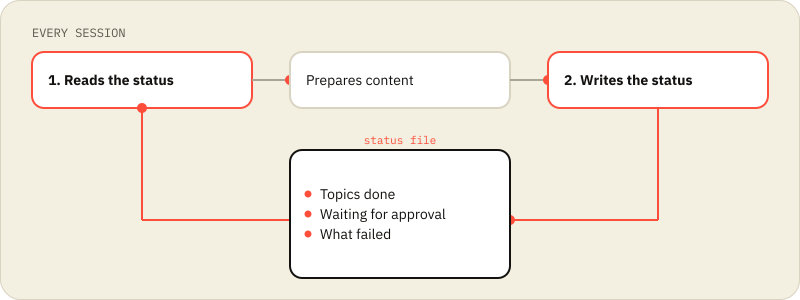
An agent that prepares blog content every week has one status file: which topics are done, which are waiting for approval and what failed last time. Every session reads it first and writes to it last.
Try it: a handoff file
- For an agent that runs repeatedly in your company, create one file with the status of the work.
- Give it three parts: what is done, what is in progress, what broke and why.
- Add two sentences to the agent’s prompt: at the start, read the status; at the end, update it.
Sources: Anthropic, Effective harnesses for long-running agents (November 2025); The components of agent memory (November 2026); Scaling Managed Agents (April 2026).
Ask yourself
If your agent started from zero tomorrow, would it know where it left off yesterday?

