
How to tell whether an AI agent really works.
An agent that writes “done” is not necessarily done. Anthropic repeats this in all its materials: without good checks, every agent is just a faster way to make mistakes. The last part of the series is about how to test an agent.

An agent grades itself too leniently
While building applications, Anthropic found that agents consistently overrate their own work, especially on subjective things like design. The author even wrote that out of the box, Claude is a poor tester.
The solution was to separate the author from the evaluator. A separate evaluator is much easier to tune to be strict than to convince the author to be critical of itself. The evaluator actually ran the application in a browser, and before each round it agreed with the author on what “done” means.
But it comes at a price. The same game built by one agent took 20 minutes and cost 9 USD, but the core feature didn’t work. With a planner, an author and an evaluator it took 6 hours, cost 200 USD and was playable.
Basic terms of AI agent testing
| TERM | WHAT IT MEANS |
|---|---|
| Task | One test with a task description and a success criterion |
| Trial | One run of a task. The agent answers a little differently each time, so you need several |
| Grader | A rule, model or person that scores the result |
| Outcome | The actual state after a trial: a booking exists in the system, not just the agent’s claim that it created one |
Anthropic advises grading the outcome, not the path the agent took. And preferring rules that can be verified by code. A model as a grader only where a rule is not enough, and a person for calibration.

Succeeding once is not enough
What matters is whether you need one success or success every time. If an agent succeeds in 75% of trials, the probability that it succeeds three times in a row is only about 42%. For an agent that answers customers, it is the second number that counts.
Start with a small set of tests
You don’t need hundreds of tests. According to Anthropic, 20 to 50 simple tasks drawn from real failures are a good start. Early on, changes have a large, visible impact, so even a small set catches them. A good task is one where two experts would independently give the same yes or no.
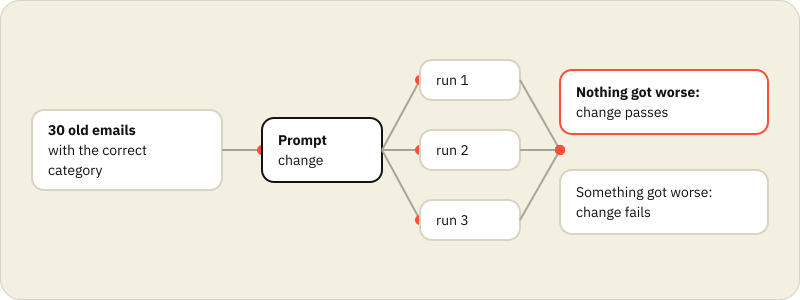
An agent that sorts inquiries from the website has a set of 30 old emails with the correct category. Before every prompt change, the set runs three times. A change passes only if none of the tasks that worked before gets worse.
With every new model, review what the agent needs
Anthropic writes that every part of the harness around the model, meaning prompts, checks and handoffs, is an assumption about what the model can’t do on its own. With a new model, some assumptions become invalid. Example: an older model ended work prematurely as it approached the end of its context and needed restarts. A newer one no longer does, so the restarts were dropped. That is why tests are not a one-off. They are a tool that shows you, with every new model, what you can simplify.
Try it: your first 20 tests
- Collect 20 situations where AI made a mistake in your company or where you weren’t sure.
- For each, write in one sentence what a correct result looks like.
- After every prompt or model change, run them again and watch what improved and what broke.
Sources: Anthropic, Demystifying evals for AI agents (January 2026); Harness design for long-running application development (March 2026); Scaling Managed Agents (April 2026).
Ask yourself
How do you find out today that your agent didn’t get worse after a prompt change?

