
Why you should audit how your company uses AI.
Most companies already use AI. The question is not whether, but who, for what, with what data and on which account. When nobody knows, the company pays for tools twice, data leaves through private accounts and everyone reinvents the same thing.

How AI usually gets into a company
Not through a management decision, but from the bottom up. A salesperson pays for Claude Pro to write proposals. An assistant uses the free version for emails. A developer has his own Max plan. Everyone has their own prompts, tricks and files they uploaded to AI. For the company, it is invisible.
There would be nothing wrong with that, except for one important thing: personal accounts follow different terms than business accounts. On the Free, Pro and Max plans, since August 2025 each user chooses whether Anthropic may use their chats to train models. If they agree, the data is kept for five years. The business Team and Enterprise plans follow commercial terms and are not used for training by default.
What an AI audit finds out
An audit is not a check of who makes mistakes. It is a map you can use to decide what to do next. It answers five questions:
- Who uses which AI tools and on which account. Personal, business, free, paid.
- What data goes into AI. Contracts, client personal data, price lists, internal figures.
- For which tasks. And which of them repeat so often that they deserve one shared procedure.
- How the tools are set up. Who has admin rights, what is shared, what is connected.
- Where the risks and the biggest savings are. Specifically, with an order of what to tackle first.

Why an audit pays off before buying licenses
Many companies start by buying licenses for everyone. A month later they find that half the people have barely opened Claude and the other half would need more. An audit shows who needs which type of license, what needs to be set up and which rules to put in place from the start. You then buy licenses based on real work, not on a guess.
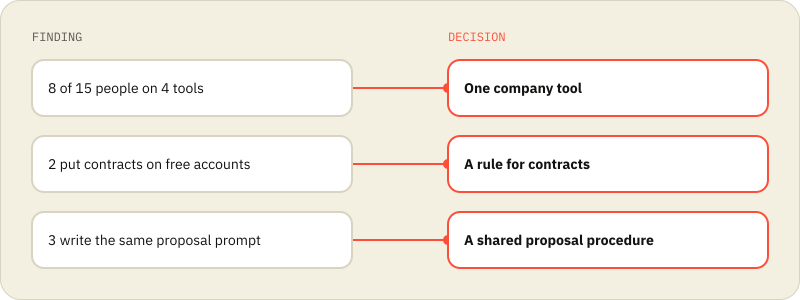
A company with 15 people finds that eight of them use AI across four different tools, two upload client contracts to free accounts and three write the same proposal prompt independently of each other. This leads to three decisions: one company tool, a rule for contracts and one shared procedure for proposals.
A 30-minute self-audit: three questions for your team
Send your team three questions, anonymously, so they answer honestly:
- Which AI tools do you use at work, and do you pay for them, does the company, or are they free?
- Which three tasks do you use them for most?
- Have you ever uploaded a contract, client personal data or internal figures to AI?
The answers will tell you more than any market survey. If the third question surprises you, you know where to start.
Sources: Anthropic, Updates to our consumer terms (August 2025); Claude, plan pricing.
Ask yourself
Can you say today how many people in your company use AI on a private account?

