
How Anthropic built a team of AI agents: research and a compiler.
We now know what an agent and a subagent are. Let’s look at two real systems Anthropic built and described, numbers included. One is the research system behind the Research feature in Claude, the other is sixteen agents who together wrote a C compiler.

The research system: a lead and researchers
When you ask Claude a complex question through Research, the orchestrator and workers pattern is at work:
- The lead agent thinks about the approach and saves the plan to memory so it doesn’t get lost when the context fills up.
- Subagents search in parallel, each in a different direction and in its own context. They don’t just search mechanically, they evaluate what they find as they go.
- The lead combines the results and decides whether more searching is needed.
- A citation agent finally assigns an exact source to every claim.
What a team of agents brought and what it costs
| METRIC | VALUE |
|---|---|
| Improvement over a single agent (Opus 4 lead, Sonnet 4 subagents) | 90.2% in an internal evaluation |
| Time saved on complex questions | up to 90% |
| Agent token use compared with chat | about 4× |
| Multi-agent system token use compared with chat | about 15× |
| How much of the performance difference token usage alone explained | 80% |
Anthropic’s conclusion is honest: a multi-agent system only pays off economically for high-value tasks. It doesn’t fit when all agents must share the same context or when the parts depend heavily on each other. According to Anthropic, this applies to most programming.

Rules Anthropic gives the lead agent
- Teach the lead to delegate. Each subagent needs an objective, an output format, guidance on sources and task boundaries. Without them, subagents do the same work twice or look for something else.
- Scale effort to the question. A simple fact: one agent, 3 to 10 tool calls. A comparison: 2 to 4 subagents. Complex research: more than 10 subagents.
- Start wide, then narrow down. Short, broad searches first, details only afterwards.
- Judge the result, not the path. An agent can reach the right answer in a different way than you expected.
The compiler: sixteen agents without a boss
In 2026 Anthropic tried the opposite approach. Sixteen agents running Opus 4.6 wrote a C compiler without a lead agent.
- Coordination was simple: a shared git repository and locking tasks with a file in a folder. Whoever locked a task first did it.
- Scale: nearly 2,000 sessions over about two weeks, costs just under 20,000 USD, a result of about 100,000 lines of code.
- Result: the compiler builds the Linux kernel and passes about 99% of tests. The generated code is slower than from the standard GCC compiler, though, and new features often broke old ones.
The author’s biggest lesson: agents solve exactly what the tests measure. When the tests are imperfect, agents solve the wrong problem. And he admits his own concern about people deploying software that nobody has personally checked.
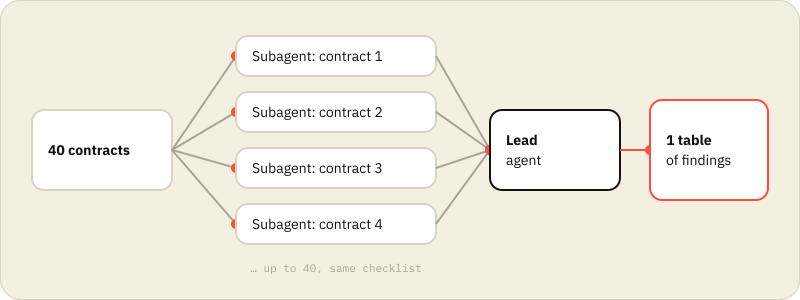
A law firm needs to review 40 contracts before an acquisition. Each contract can be assessed by its own subagent against the same checklist, and a lead agent combines the findings into one table. The contracts don’t depend on each other, so parallel work makes sense.
Try it: write a task for a subagent
- Take a task where AI has to read a lot of material.
- Add the four things Anthropic gives every subagent: an objective, an output format, where to draw from and what is no longer its job.
- Compare the result with a task description without these four points.
Sources: Anthropic, How we built our multi-agent research system (June 2025); Building a C compiler with a team of parallel Claudes (February 2026).
Ask yourself
Which task in your company can be split into independent parts that can run at the same time?

