
When you don’t need subagents: one AI agent with skills.
Judging by the numbers from the research system, it would seem that more agents are always better. In October 2026 Anthropic wrote the opposite: in many companies one agent with skills works better than a team of subagents. How can both be true at once?

Why subagents came about
Subagents were a solution to the problem of an overloaded context. The main agent had too many tools and instructions at once, so the work was split between specialists. Each had its own short list of tools and its own task.
What changed: skills and progressive loading
A skill is a folder with instructions on how to do a certain job, possibly with scripts and resources. Anthropic compares it to an onboarding guide for a new colleague. What matters is how it loads: at the start, the agent sees only the name and a short description of each skill. When a skill fits the task, it reads the full instructions. It opens further files from the skill only if it really needs them.
The agent’s desk stays clean even without subagents. Thanks to this, Anthropic cut Claude Code’s system prompt by more than 80%.

What Anthropic saw in companies
- One agent with skills often beat both a single big prompt and a team of subagents, at a lower cost and with faster answers.
- One customer sped up a run roughly twofold after merging subagents into one loop.
- A company with about a dozen specialized subagents could not keep a consistent tone of answers, and customers disliked the waiting.
The reason is simple: with every handoff, details get lost. One agent has the whole story in front of it and can connect what it found out a moment ago.
When a subagent still makes sense
| SITUATION | RECOMMENDATION |
|---|---|
| One agent measurably gets worse because its context is overloaded | Subagent |
| Several independent tasks at once, each with a fresh context | Subagents in parallel |
| The agent confuses tools or has conflicting rules in its prompt | Subagent or a cleaned-up prompt |
| A specialist must talk directly to the customer | Conversation handoff |
| Everything else | One agent with skills |
Watch the number of tools too. According to Anthropic, tool selection gets worse when the agent has roughly 30 to 50 of them in its prompt. The solution is to group tools by what the user wants to do and load them only when needed.
And what agent teams in Claude Code are
Claude Code also has experimental agent teams. A subagent gets a task, does it and returns the result, it doesn’t talk to the others. A team member is a separate session: the team has a shared task list and members message each other directly and can challenge each other. Teams suit research, reviews and finding the cause of a bug. But they are considerably more expensive and the documentation advises starting with 3 to 5 members.
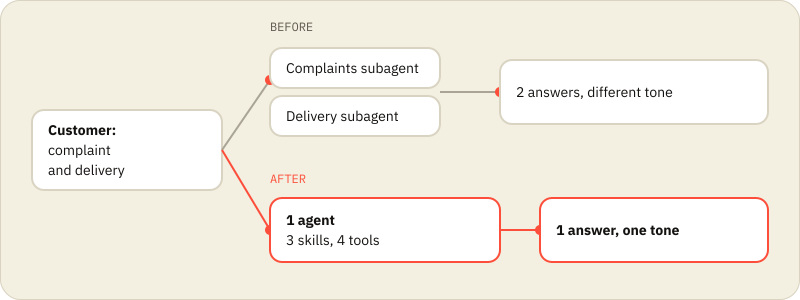
An e-shop’s customer support has subagents for orders, complaints and delivery. After merging, one agent remains with three skills and four tools into the systems. A customer asking about a complaint and delivery at the same time no longer gets two answers in a different tone.
Try it: a test before merging subagents
- Prepare about 10 sample tasks with the correct answer.
- First merge the subagents that depend on each other most.
- Merge only one at a time: turn its prompt into a skill and its tools into tools of the main agent.
- Compare the results task by task, running each several times. Keep the subagent only if the merged version is worse.
Sources: Claude, Building agents: when to fold subagents into your main agent loop (October 2026); Anthropic, Equipping agents for the real world with Agent Skills (October 2025); Claude Code documentation, Agent teams.
Ask yourself
How many agents or subagents does your company have today, and do you know what would happen if you merged them?

