
What an AI agent is and how it differs from chat and automation.
The word agent gets stuck on everything today, from a chatbot to an Excel macro. Yet Anthropic has a clear distinction. Once you understand it, you will know what you are actually buying and what you need.

Three levels: answer, procedure, agent
Imagine three people in a company.
- The first answers a question. You ask, they answer, done. That is an ordinary chat with AI.
- The second works from a checklist. Step 1, step 2, step 3, always the same. Anthropic calls this a workflow: AI and tools are orchestrated “through predefined code paths”.
- The third gets a goal and chooses the procedure. They decide what to find out, which tool to use and when the job is done. That is an agent: the model “dynamically directs its own processes and tool usage”.
Anthropic calls all three together agentic systems. The difference is who decides on the next step: your code, or the model.
What an AI agent is made of
Anthropic calls the basic building block the augmented LLM. It is a model that has been given three things: retrieval, to find information beyond its own memory, tools, to be able to act, for example send an email or write to the CRM, and memory, to remember what it has already done.
Tools today are often connected through MCP, a common language between AI and company systems. An agent is then a model that works with these tools in a loop until it finishes the task.

When you really need an agent
Anthropic advises starting with the simplest solution and adding complexity only when it is needed. Agents are slower and more expensive, but they can handle more. According to Anthropic, one well-set model call with documents and examples is often enough.
| SITUATION | WHAT IS ENOUGH |
|---|---|
| One question, one answer | Chat or a single model call |
| The task has fixed steps you can describe in a few sentences | Workflow |
| You can’t say in advance how many steps it will take or which | Agent |
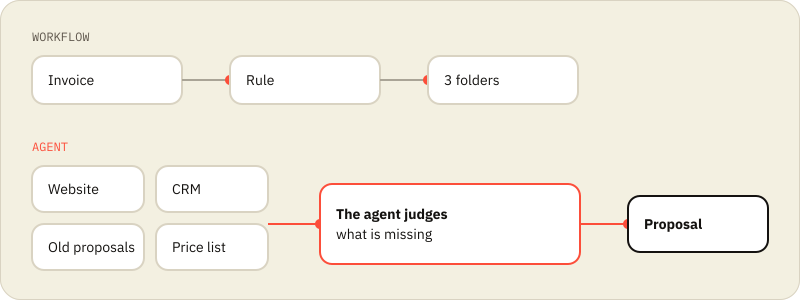
Sorting invoices into three folders is a workflow. Preparing a proposal for a new client, when you need to look at the website, the CRM, old proposals and the price list and judge what is missing, is a task for an agent.
Three principles Anthropic keeps repeating
- Simplicity. The fewer parts, the fewer places where something breaks.
- Transparency. The agent should show how it plans, so you can see why it decided the way it did.
- Well-described tools. For its coding agent, Anthropic spent more time tuning the tools than tuning the prompt. It also helps to change a tool so that it is harder to make a mistake with it.
Try it: sort your tasks
- Write down five activities you would like to hand to AI.
- For each, answer: can I describe the steps in advance? Yes means workflow, no means a candidate for an agent.
- For the candidates, add which tools the agent would need and what it must not do without you.
Ask yourself
Which task in your company would you hand to an agent today, and which is enough to automate?

