
What a subagent is and why an AI agent hands work to helpers.
A subagent is not a smarter model. It is the same model with a clean desk. To understand why it exists, you first need to understand what slows AI down most at work: an overloaded context.

Context is a desk
Everything the model sees while working is its context: the task, instructions, examples, tool results and the whole conversation so far. Think of it as a desk. It can be large, but the more papers lie on it, the harder it is to find anything.
Anthropic described it precisely. As the number of tokens in the context grows, the model **recalls** information from it **less well**. This applies to all models, only the rate of decline differs. A model has limited attention and every additional token takes a slice of it. That is why Anthropic talks about context engineering: finding “the smallest possible set of high-signal tokens” that leads to a good result.
A subagent: the assistant who goes to the archive
When an agent needs to go through a hundred documents, it doesn’t have to put them all on its own desk. It sends an assistant. The assistant spreads out what is needed in the archive, reads it and comes back with one page of notes. That is exactly what a subagent is:
- it has its own, clean context window,
- it gets a task from the main agent,
- it can use tens of thousands of tokens while working,
- it returns a summary, often 1,000 to 2,000 tokens, to the main agent.

How subagents work in Claude Code
In Claude Code, a subagent is an ordinary text file. At the top it has a short header, below it instructions that become its system prompt. The header mainly holds the name, a description of when the main agent should hand it work, a list of tools it may use, and the model it runs on, for example the cheaper Haiku.
Claude Code also has built-in subagents. Explore quickly searches code and files and may only read. Plan gathers information during planning. General-purpose handles more complex tasks that need both searching and acting. The documentation lists five reasons to use a subagent: it keeps the main context clean, limits tools, can be reused, has its own specialization and can run on a cheaper model.
Two things that surprise people
- A subagent doesn’t see your conversation. It only gets its instructions and the task from the main agent. What the main agent doesn’t tell it, it doesn’t know.
- A subagent is not free. Each one uses its own tokens and its result returns to the main context anyway. For small things it doesn’t pay off.
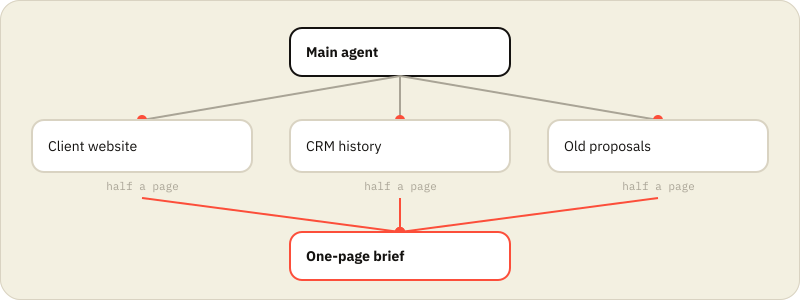
Before a client meeting, the main agent sends out three subagents at once. One goes through the client’s website, the second the CRM history, the third old proposals. Each returns half a page. The main agent turns it into a one-page brief.
Try it: find work that clutters the desk
- Think of a task where AI has to read a lot of material, but you only need a short conclusion.
- Write one sentence for the subagent description: when the task should be handed over.
- Write exactly what the subagent should return, for example “five points and a list of sources”. Without this instruction it will return too much.
Sources: Anthropic, Effective context engineering for AI agents (September 2025); Claude Code documentation, Subagents.
Ask yourself
For which task does your AI read far more than it actually uses?

