
How an AI agent works: the find out, act, check loop.
An agent is not magic. It is a model that repeats three steps over and over until the job is done. Anthropic uses this cycle in all its agents, from Claude Code to business tools.

Give AI a computer
Anthropic started with the coding agent Claude Code. It gave the model a terminal, the same tools a developer has. It turned out that with a computer it can handle other work too: it reads spreadsheets, searches the web, draws charts. This led to the core principle: “give your agents a computer, allowing them to work like humans do”. The Claude Agent SDK, a set of tools for building your own agents, stands on the same foundation today.
The three steps of the AI agent loop
1. Find out what is needed. The agent first gathers information. It doesn’t load the whole archive, it searches like a person: it looks at the folder structure, searches for a word, opens only the file it needs. Anthropic recommends starting with exactly this kind of search and adding vector search only when needed.
2. Take a step. The agent acts through tools. There are four kinds:
- Custom tools, for example “create invoice”. These are the main actions the agent considers.
- The command line and scripts for general work with the computer.
- Its own code, when something needs to be precise and repeatable, such as a calculation.
- MCP to connect services such as Slack, Google Drive or a CRM.
3. Check whether it worked. This is the step that makes an agent reliable. Anthropic writes that agents that can check and improve their own output are fundamentally more reliable. Checking takes three forms: rules, for example whether totals add up, visual feedback, when the agent takes a screenshot of the result and looks whether it fits, and another model as a judge for fuzzy criteria. According to Anthropic, that one is less reliable and slower.

Then the loop starts again, until the task is done or until the agent reaches a boundary where it should ask a person.
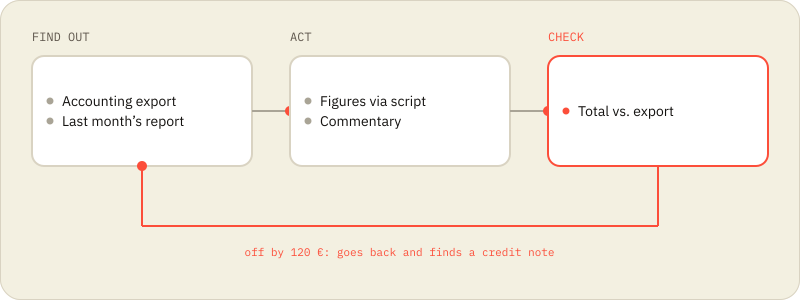
An agent has to prepare a monthly revenue report. Find out: it finds the export from the accounting system and last month’s report. Act: it calculates the figures with a script and writes a commentary. Check: it compares the total with the export. It is off by 120 €, so it goes back and finds a credit note it had overlooked.
Why checking matters most
A model without checks relies on having got it right. A model with checks gets feedback from the world, which Anthropic calls “ground truth from the environment”. That is why a good agent doesn’t end with the sentence “done”, but with proof that it is done.
Try it: break one task into the loop
- Pick one task you do by hand today.
- Write three lines: where the agent would get its information, which steps it would take and how it would verify that the result is correct.
- If you can’t write the third line, an agent is not a good idea yet. First get clear on what a correct result looks like.
Sources: Anthropic, Building agents with the Claude Agent SDK (September 2025); Building effective agents (December 2024).
Ask yourself
For your tasks, can you say how an agent would verify that the job is done?

